With AI summaries now sitting right up front in people’s searches, it makes me wonder how many folks are bothering to go beyond that. Does this mean fewer folks are clicking through to websites? They read the AI summary at the top of Google and stop there. Or they open their preferred AI/LLM and ask, "Who's a good speech pathologist in the inner west?" and that’s where their first few enquiries go.
This month, I explored exactly this in a recent strategy session with an architect client. They felt the only visitors their site was attracting were bots, and when I asked an AI tool to recommend an architect in their area, they didn't make the list. Now their work wasn't the problem; it’s so incredibly amazing in every way. Their website just wasn't telling AI (or Google, for that matter!) clearly enough what type of architect they are, who they are and where.
Some of what we found: page titles described her as a generic "firm" in Melbourne rather than a Bespoke practice, the homepage had no main heading for search tools to read, there were no details about which area in Melbourne they were based in, and there weren’t enough Google reviews to make the AI cut. So we set about fixing that, with one clear goal: using plain language to connect with more leads.
This AI stuff changes the job your website has to do. It's no longer just about ranking on page one. It's about being clear enough, specific enough and trustworthy enough that when an AI tool goes looking for an answer, your business is part of it.
So what do we do? This space is moving quickly. It’s not about rebuilding or learning a bunch of new acronyms. Most of what helps AI understand you is the same stuff that has always helped humans: being clear about what you do, who it's for and where you are.
What's actually changed
AI tools like ChatGPT, Gemini and Google's AI Overviews pull information from across the web, summarise it and serve up a single answer. Sometimes they link to their sources, sometimes they don't.
If your website is vague, they fill the gaps with whatever else they can find (Yep! Not ideal - but here we are!). That might be an old directory listing, a review site, or a competitor who simply explains themselves more clearly.
So the question isn't "Is my website pretty?" It's "If an AI read my website, could it describe my business accurately in one sentence?"
What's new for Squarespace sites
If you're on Squarespace 7.1, there are two new features worth knowing about.
AI Visibility
You can run real prompts, like "best florist in Yarraville", and see whether your business shows up in ChatGPT and Gemini answers. Re-run them over time to see if your updates are making a difference. For now it's only available on English-language 7.1 sites, and only covers ChatGPT and Gemini.
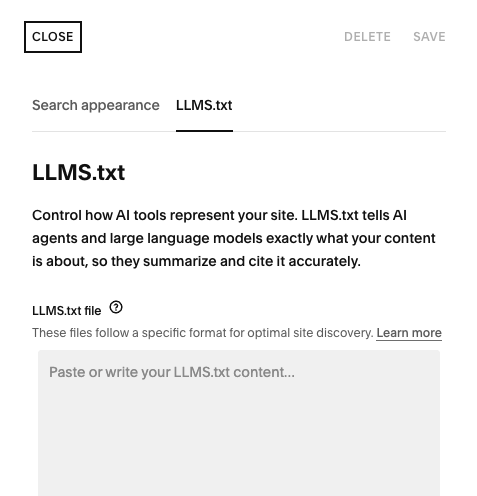
llms.txt
A simple file that points AI tools to your most important pages. But the important question to be asking here is… Are the AI tools using it? The Squarespace description oversells it a little (at this stage at least). The settings panel suggests it tells AI tools exactly what your business is about, so they summarise and cite you accurately. In reality, it’s a signpost (similar to a sitemap) that AI tools can read, not an instruction they have to follow. Google has said it doesn’t use it yet, and early research suggests most AI tools rarely check it at all. I still think it’s worth ten minutes to set up, but it’s not the fix. Clear copy, good structure and real reviews are what actually make the most impact.
What's new for Shopify stores
Shopify has gone big on what it calls Agentic Storefronts. It shares your product catalogue with AI shopping assistants like ChatGPT, Microsoft Copilot and Google's AI Mode, so shoppers can discover your products right inside the conversation. There's also a dashboard showing orders from those channels.
A quick Aussie caveat: the rollout started with US merchants and eligibility rules apply. Check your admin under Settings, then Apps and sales channels, to see if it's switched on for you.
Either way, the foundations are the same. Clear product titles and descriptions, accurate stock and pricing, and complete store policies make it easier for any AI tool to understand and recommend what you sell.
What actually helps, on any platform
New features are handy, but they only work if the basics are in place. Here's my checklist:
Say what you do in plain words
"Paediatric speech therapy in Footscray" beats "Helping little voices bloom" every time.
Name who you help and where
Suburbs, regions (Think… Inner West Melbourne) and the types of clients you work with.
Answer the questions people actually ask
An FAQ section is gold. AI tools love a clear question with a clear answer.
Keep your details consistent
Your website, Google Business Profile, socials and directories should all say the same thing. Mixed messages confuse AI and then it makes up stuff to fill in the blanks.
Collect and show reviews
AI tools often lean on what other people say about you, not just what you say about yourself.
Keep it current
Old services, old prices and old team members all send the wrong signal. Clean up your site and make sure it’s current.
Try this today
Open your AI assistant and ask the question your ideal client would ask: "Who's a good [your service] in [your suburb]?"
Then ask: "What does [your business name] do?"
Did you show up? Was the description right? If the answer is no, or "sort of", that's not a crisis. It's a to-do list.
Want a hand?
This is exactly the kind of thing we could cover in a strategy consult session. We can review how your site is tracking and put together a clear checklist of what needs to change to support your visibility. We'll run an AI visibility check together, see how AI tools currently describe your business, and talk through the simplest fixes for your site.
I want those leads landing in your inbox, not someone else’s. Not sure if this service is right for what you need? Book a discovery call with me, and I’ll help you get it sorted.